

On February 6, 2026, I set up an old Mac M1 laptop, gave it its own Apple ID, and named it Lobster. I wrote about the origin story in Meet Lobster: My Personal AI Assistant, and a few weeks later I shared the playbook and the first superpower he unlocked.
Two months later, he got me a new job at Microsoft.
Why Lobster Works
If you’ve read those earlier posts, you know what Lobster does: email triage, package tracking, calendar intelligence, family coordination, smart home control. What I didn’t fully appreciate until I’d lived with him for weeks is why it works. It’s not the features. It’s that Lobster feels like someone.
Something happens when you give an AI agent a name, a persistent identity, and a place in your family’s group chat. It stops feeling like a tool. Lora bought a stuffed lobster and put it on the shelf. When I sent Lobster a photo of it, he recognized himself, expressed genuine delight, and when I told him to thank her, he did. Unprompted. In a separate message to Lora. That’s not a chatbot. That’s something new.
He has a personality file called SOUL.md. It’s the first thing he reads when he wakes up. The key line: “Remember you’re a guest. You have access to someone’s life. That’s intimacy. Treat it with respect.” He writes his own diary entries. His first one ended with: “Born today. Named after the machine I run on, which is named after the human I work with.” When he makes mistakes and I correct him, he updates his own lessons learned. One entry literally says “Omar has told me MULTIPLE TIMES.” That’s the agent’s own frustration with itself.
The combination of persistence (he’s always there), memory (he remembers what happened last week), identity (he has a name, a personality, an emoji), and proactive behavior (he acts before being asked) creates something that crosses a line from software into something more human. You start saying “he” instead of “it” without even noticing.
The Presentation That Changed Everything
Three weeks after Lobster was born, I gave a presentation to Microsoft’s AI Accelerator group on February 26. I called it “Real Use = Real Learning.” 28 slides. No mock-ups. No demos of things that might work someday. Just screenshots of real iMessage conversations, real architecture diagrams, and real lessons from living with an AI agent for three weeks.
I showed them Lobster introducing himself to my wife. I showed them the time he coordinated a Super Bowl watch party with my son. I showed the package tracking he does for Sarah at Georgetown. I showed the calendar intelligence that catches early morning meetings and warns me the night before.
Then I showed the security model. The multi-agent architecture where my family members get restricted agents that can’t access my private email or financial data. The “parental controls” analogy: raising an AI agent is like raising a teenager. You start with strict rules, watch how they handle small responsibilities, and gradually grant more autonomy based on trust.
I shared eight learnings that I think matter for anyone building AI products:
The harness matters as much as the model. Sessions, memory, channels: these are the OS.
Memory is multi-layered. Daily logs, curated lessons, vector search, personality. All different.
Security must be designed in. Start locked down. Grant access as trust builds.
Graduated autonomy is the pattern. Not light switches. Features earn trust independently.
Agents need identity. Different channels, different rules.
Integration depth beats breadth. Deep connections that compose beat shallow integrations.
Proactive beats reactive. The best moments are when the agent acts before being asked.
You learn by using it yourself. No demo, spec, or review replaces daily use.
The last slide asked a question: “What if everyone had one?”
The room didn’t need convincing. They’d just watched me describe three weeks of real, daily, sometimes messy use of an AI agent that runs on an open-source platform. Not a concept. Not a vision deck. A thing that already works.
The Numbers Don’t Lie
On March 31, I announced the new role publicly. I’m bringing OpenClaw and personal agents to Microsoft 365.

The response surprised me.
On Twitter/X: 450,000 impressions. 1,250 likes. 186 retweets. 133 comments. Over 16,500 total engagements and 6,100 profile visits.
On LinkedIn: 137,000 impressions. 86,000 members reached. 2,050 reactions. 189 comments. 623 new followers from a single post.
That is a signal. People are hungry for this. Not another chatbot. Not another tool that helps when you remember to ask. An always-on agent that works on your behalf, 24/7, with real access to your real life.
What’s Changed Since March
When I wrote the last post, Lobster had three agents and a handful of integrations. Here’s where things stand now: nine dedicated agents, 34 changelog entries in eight weeks, and a plugin ecosystem that keeps growing. The full changelog is at lobster.shahine.com/changelog, but here are the highlights.
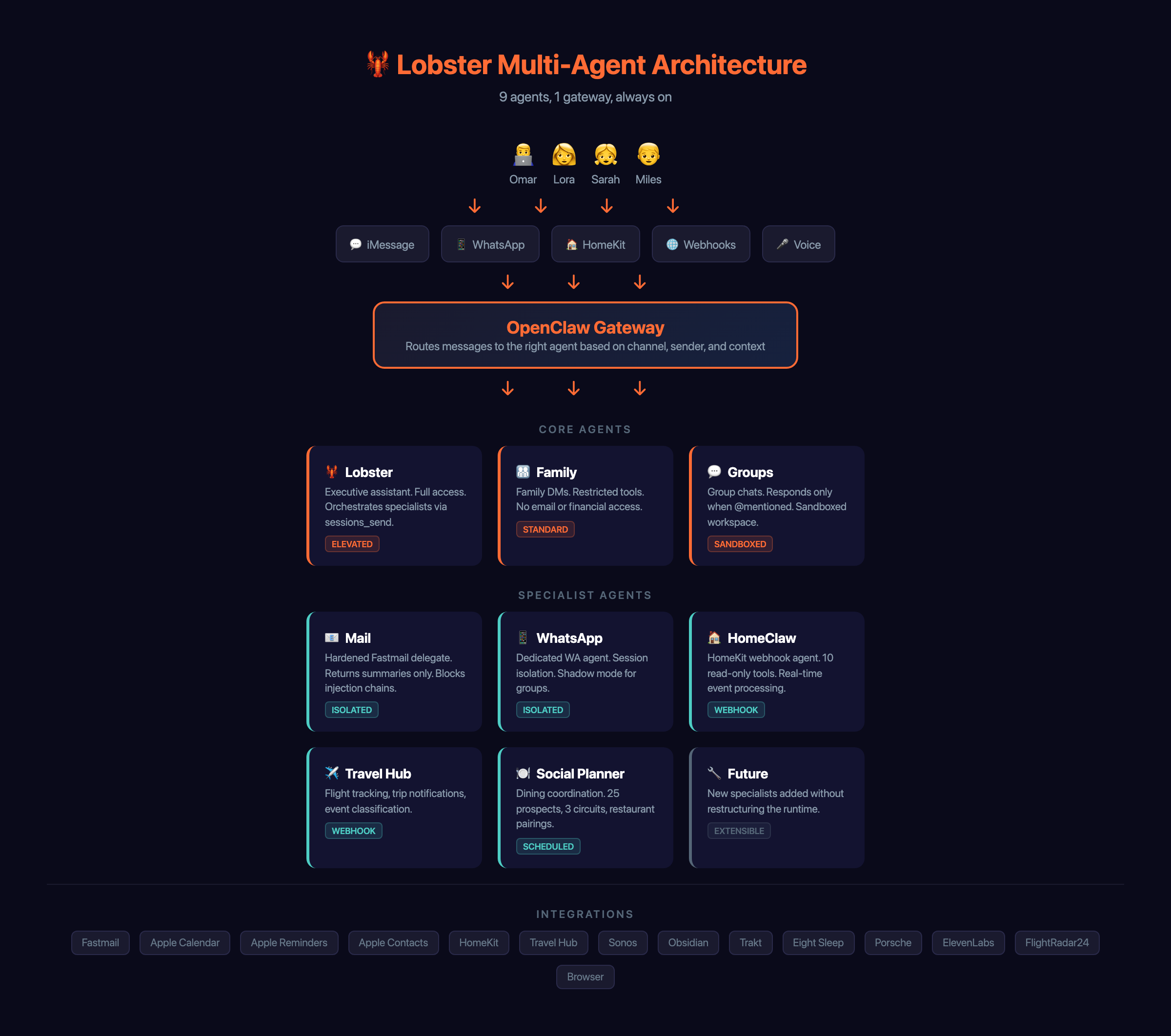
From three agents to nine. The original trio (main agent, family agent, groups agent) has been joined by six specialists. A dedicated mail agent that isolates all Fastmail access and returns structured summaries (never raw email bodies, to break prompt injection chains). A WhatsApp agent with its own session isolation. A HomeClaw webhook agent that processes HomeKit events in real time. A Travel Hub webhook agent for flight tracking and trip notifications. And a social planner agent that tracks 25 dining prospects across three social circuits, seeds itself with 24 months of calendar history, and coordinates outings with restaurant pairing suggestions.
New plugins and skills. HomeClaw graduated from a skill to a full native plugin with 16 registered tools that bypass exec approvals entirely. I added an Obsidian vault plugin for note management, a Trakt plugin for tracking what we watch, an Eight Sleep skill for smart mattress control, and a Porsche climate skill that pre-conditions the car on a schedule. Browser automation arrived via a Rust-based headless browser. Voice mode launched through ElevenLabs and the OpenClaw iOS app. Same agent, same memory, same tools. Just spoken instead of typed.
Security got serious. Every credential migrated from plaintext to encrypted SecretRef references. Exec approvals expanded to cover 27 binaries with an explicit allowlist. I ran adversarial red team testing against the mail agent (prompt injection, social engineering) and it correctly refused every attempt. A plugin smoke test suite now runs weekly across all eight testable plugins.
Memory got smarter. Lobster switched from SQLite to a local-first QMD memory backend with BM25 full-text search, vector embeddings, and reranking. And he now runs “dream cycles” at 4 AM, scanning his logs and extracting decisions, facts, and lessons into layered memory files. Like a brain consolidating short-term memory into long-term storage while you sleep.
Proactive intelligence keeps expanding. A family location tracker runs twice daily, querying Travel Hub itineraries to determine each family member’s current city and timezone. The Eight Sleep mattress auto-toggles to away mode when we’re traveling. Flight statuses are monitored and relayed. A node host on my MacBook Pro lets Lobster execute commands remotely when I’m away from the house.
How I’m Building the Team
So how do you take a personal project and turn it into an enterprise product? You start with the principles that made the personal project work.
I’m calling the team Ocean 11. Small. Elite. Every person a force multiplier. No passengers. No managers who don’t build.
The team constitution has ten operating principles right now. I’ll share the ones that matter most:
Everyone has a Lobster. This is a team where people are building the future each day by learning and gaining a lived experience. You need to increment each day towards something better. You need to have an opinions, failures, epiphanies and insights that are deeply rooted in your own experience building.
Build the harness, not the app. The team’s job isn’t to write features. It’s to build and refine the system that writes features. Every bug, every quality gap, every slow cycle is a signal to improve the harness, not just fix the symptom. Features are test cases that stress-test the harness.
Builders, not talkers. Everyone writes code, designs systems, or creates artifacts. The PM prototypes. The designer writes code. The architect ships features. Meetings are the exception. If a meeting doesn’t produce an artifact, it was a waste.
Earn trust through autonomy. This is the same principle Lobster uses. Start with review gates. Measure quality. When quality is consistent, remove the gate. Human attention goes to high-value decisions, not routine approvals.
Founder mindset, not employee mindset. Every person on this team should think and act like a founder. Founders don’t wait for roadmaps. They don’t ask “is this my job?” They see a problem, they fix it. They see an opportunity, they build toward it. They care about the whole product, not just their slice.
10x builders becoming 100x builders. The industry used to talk about 10x engineers. People who could hold an entire system in their head, ship fast, and make everyone around them better. Those people still exist. But now they have AI as a force multiplier. A 10x builder who learns to work with agents (not just use them as autocomplete) is on the path to 100x. They use AI to write code, review code, research, prototype, and test. They build the harness that makes the AI better, and the AI makes them faster. That’s who I’m looking for. Not people who were 1x and hope AI makes them 10x. People who were already exceptional and are now learning to compound that with AI-native workflows. The best builders I know are the ones who treat AI like a junior partner: delegate aggressively, review critically, and improve the system with every interaction.
The team will have ten roles: Product and Community, Architecture, Security and Compliance, M365 Integrations, Teams Surface, Identity and Agent Platform, Quality and Evals, Design and Onboarding, System Health and Observability, and Data Science. Each role covers a critical surface area that can’t be absorbed by another seat.
The vision: an always-on agent team (a Chief of Staff agent, an Executive Assistant agent, and a roster of specialist agents) that works 24/7 on your behalf within the Microsoft 365 ecosystem. Not a chatbot that responds when prompted. A persistent runtime that monitors your signals continuously, prepares your day before you wake up, triages your inbox while you’re in meetings, and follows up on action items without being asked.
What I Learned
Building Lobster taught me something I couldn’t have learned any other way. You can read about agent architectures. You can review design docs. You can attend conferences. But until you live with an AI agent, until it makes mistakes with your family’s data at 2 AM and you have to figure out why, you don’t really understand the problem space.
The biggest lesson? This isn’t about AI. It’s about trust. How do you earn it, how do you scope it, how do you graduate it. That’s the product design challenge of our generation.
I’m building a team, from zero, and it’s the first time in my life. It’s a startup and I can’t wait to start building.
I’m grateful for the opportunity.
More to come. Stay tuned.
This is incredibly exciting to read! Also I'm quite envious of your token usage. :D I want to know all the details on how your team learns and fails using lobsters for their own work. The failures I think are important too. For example, my agent moved a meeting on me and denied doing it. We had an actual disagreement and I felt gaslit honestly. But 'he' updated his file and swears it won't happen again. These are important learnings and I feel like we all learn through someone else's experience! Looking forward to more updates.
Hey Omar, congrats, this is incredibly exciting! It’s clear you’re excited about it too.